The Forest Bridge – A Mid North Coast Koala Corridor Proposal
What is the Forest Bridge?
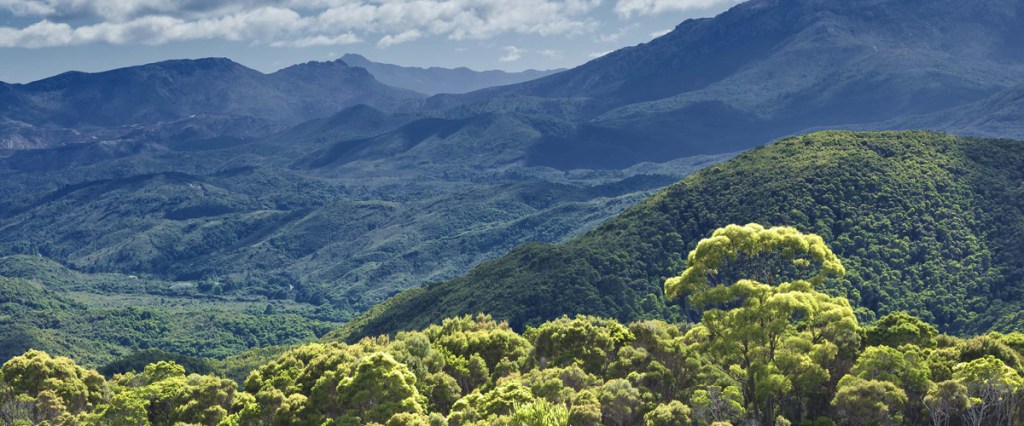
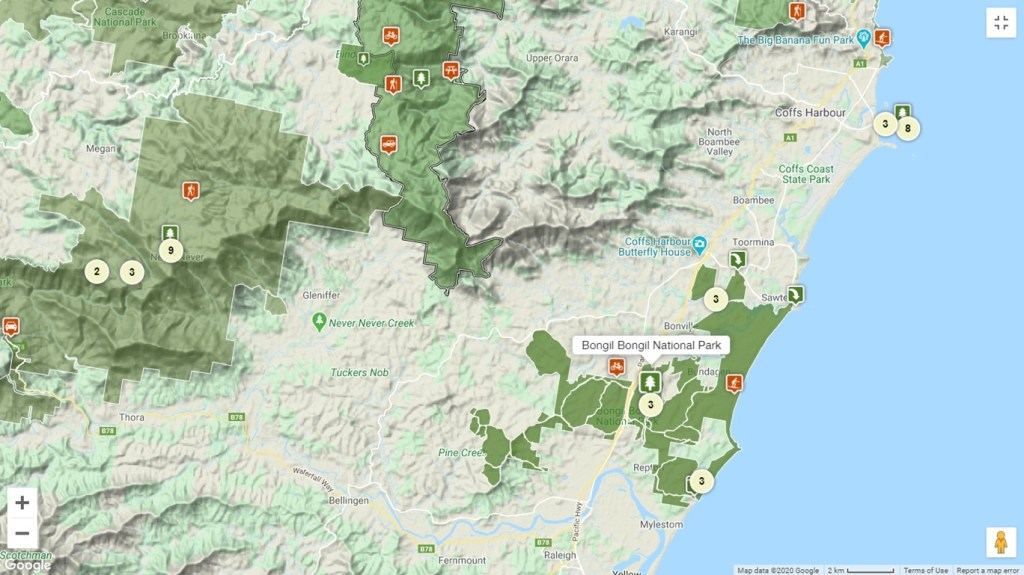
The ‘Forest Bridge’ proposal seeks to permanently conserve a critical corridor of public State Forest as a wildlife corridor west of Coffs Harbour on the Mid North coast of NSW. It offers a unique opportunity to permanently protect and complete an east/west corridor of conserved land stretching from the coastline at Bongil Bongil National Park westward to Point Lookout within New England National Park and beyond. In 2021 both Bongil Bongil National Park and Bindarri National Park were listed as Assets of Intergenerational Significance by the Minister for Energy and Environment, warranting them special protection.
Where is the Forest Bridge?
The gap between these two National Parks is currently occupied by small sections of Pine Creek State Forest and Tuckers Knob State Forest both under constant threat of destruction through high intensity logging. Parts of this country have already been clear-felled and bulldozed for monocultural Blackbutt (Eucalyptus pilularis) plantations. Blackbutt is not a primary koala food tree.
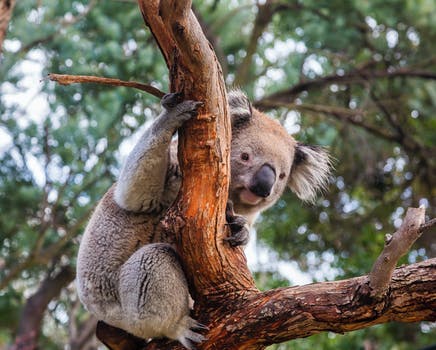
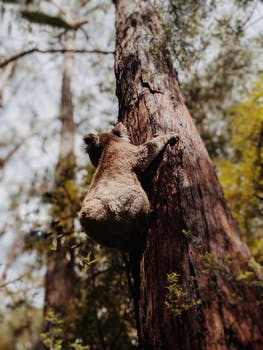
The Pine Creek State Forest koala population has been recognised as one of state significance. As Dr Andrew Smith (Koalas in the Pine Creek Study Area: Conservation Significance and Recommendations for Management, Austeco, 1996) states:
Available evidence indicates that Pine Creek Forest is the most important of all State Forests in the Coffs Harbour region for koala conservation for the following reasons:
- It has the highest density of known koala records
- It has relatively low relief (ruggedness) which is known to be preferred by koalas (NPWS 1994)
- It provides a connecting corridor between coastal koala habitats of Bongil Bongil National Park and hinterland habitats.
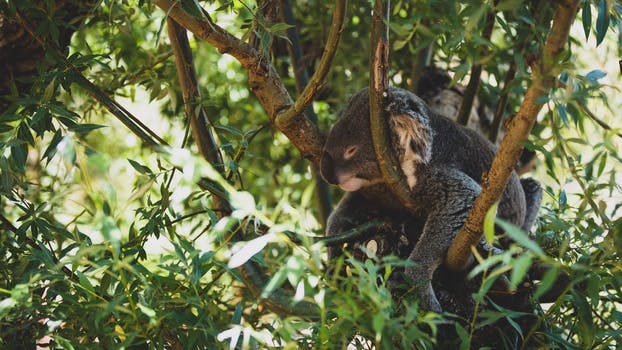
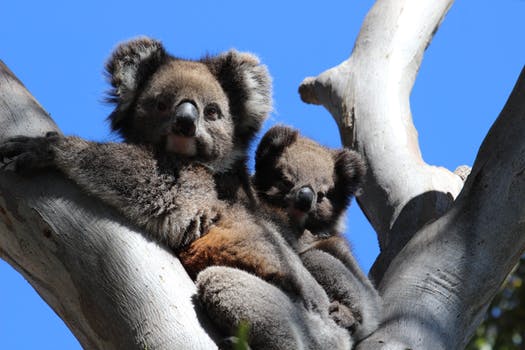
This proposed wildlife corridor is largely in place. The ‘Forest Bridge’ proposal adds the missing section to this nationally important wildlife habitat continuum of permanently conserved public forest.
Bongil Bongil National Park
The proposal entails the addition of around 1,650 hectares of land to Bongil Bongil NP, one of the most important areas for Koala conservation on the east coast of Australia and therefore, the world. This national park is renowned for containing superb habitat for an estimated 400-500 koalas, but their safe movement westward is currently constrained by ongoing forestry operations within existing native forest in public ownership.
Bushfires 2019/2020
A report by specialist koala ecologist Stephen Phillips, commissioned by WWF for Nature Australia and released in September 2020 showed a 71% decline in koala populations across six locations in northern NSW, burned in 2019/2020 bushfires. However Bongil Bongil NP and its adjacent State Forests suffered no impact from the deadly Black Summer fires of 2019/2020 and remained entirely unburnt. Its present-day value and importance to the perpetuation of the wild koala in NSW is therefore immeasurable.
Land Bridge
This unparalleled opportunity, if realised, will provide a secure and permanently protected land bridge for native terrestrial and arboreal wildlife that will allow native animals to safely and securely move east/west from 0 metres altitude on the Pacific Coast at Bongil Bongil westward to over 1500m altitude at the magnificent world heritage area of New England National Park.
Only one narrow mountain road, the Waterfall Way west of Bellingen, interrupts this continuous green forest belt under public ownership. From Point Lookout in New England NP this conserved landmass extends further southward to the Great Dividing Range west of Port Macquarie. It includes Bongil Bongil NP, Bindarri NP, Dorrigo NP, Bellinger River NP, the World Heritage Area of New England NP, Cunnawarra NP, Oxley Wild Rivers NP, the World Heritage Area of Werrikimbe NP and Cotton Bimbang NP.
State Forest Compartments required
The area of public lands required to complete the Forest Bridge is relatively small at approx. 1,650 hectares. Through the transfer of compartments 7, 8 ,9 and 14 to 33 within Pine Creek State Forest and compartments 5, 6, 7, 8 and 9 of Tuckers Nob State Forest this hugely important east/west wildlife corridor could become a reality. Existing plantations on the external perimeters of compartments 14 and 21 and 24 to 33 could be retained by Forestry Corporation but compartment 22 and 23 MUST be included in their entirety.
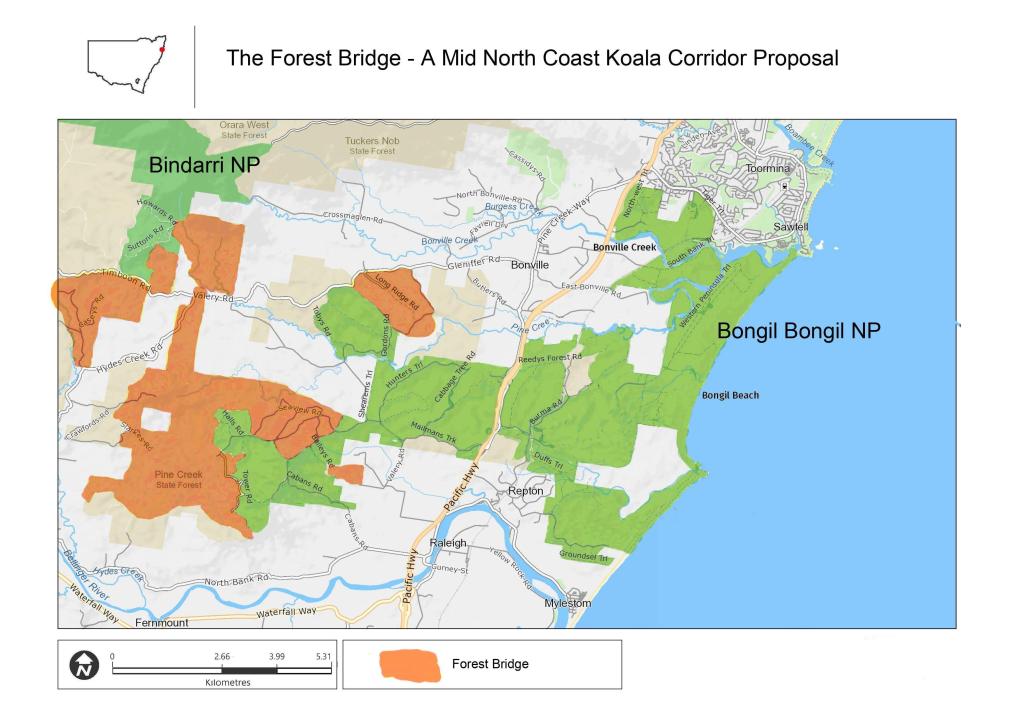
Part of the required compartments 20 and 21 within Pine Creek SF is high conservation value native forest on the steep slopes of Hubbard’s Peak, an area not available and therefore permanently quarantined from timber harvesting due to its steepness and erosion potential. Transfer of this area would be at little to no economic cost to the NSW Forestry Corporation.
The remainder of the required compartments in Pine Creek SF are mainly classified by Forestry Corporation as General Management Zones with Compartments 7, 8 and 9 yet to be classified. These latter three compartments contain ‘The Sawmill’ mountain bike trails, and if transferred to NPWS, mountain biking could continue along with preserving the landscape.
A Brief History of Forestry Management at Pine Creek, a report prepared for the Forestry Commission of NSW by RL Newman and partners, 1997 indicates that the compartments required contain forest types supportive of koala populations that are ‘largely intact (as an ecosystem), are high in diversity and ecological values’ and ‘have little wood production potential in their current condition and have attributes (including old-growth trees) to justify their retention, protection and restoration under any future management regime’.
By area, the majority of the required compartments in Tuckers Knob SF are classified by Forestry Corporation as Hardwood Plantation Zones, indicating these areas are under future threat of timber harvesting.
Private additions
The proposal may also include, with local landholder support, permanent protection of some magnificent native forest land under private ownership within this corridor precinct. While much of this native private forest is already protected under Bellingen Shire Council zoning regulations, additional protection could be achieved by way of conservation covenants under the Biodiversity Conservation Act. These private forest areas remain under threat from logging under Private Native Forestry agreements.
Other benefits
The Forest Bridge wildlife corridor would be of enormous value in accelerating high levels of gene flow for numerous other threatened native fauna including Squirrel Glider, Brush-tailed Phascogale, Tiger Quoll and the Yellow-bellied Glider, wide ranging native animals heavily dependent upon a large amount of continuous native forest for food, habitat and perpetuation in the landscape.
The securing of this corridor within the State’s national parks estate would ensure ongoing restoration and strengthening of the corridor’s value to wildlife through professional NPWS management via weed control, planting out degraded Forestry plantation areas with a wider variety of preferred koala habitat trees, careful management of fire and facilitating public visitation and enjoyment.
Help us help our forests. Whatever we do, we cannot do it without you.

 Friends of Pine Creek