Where is Pine Creek?
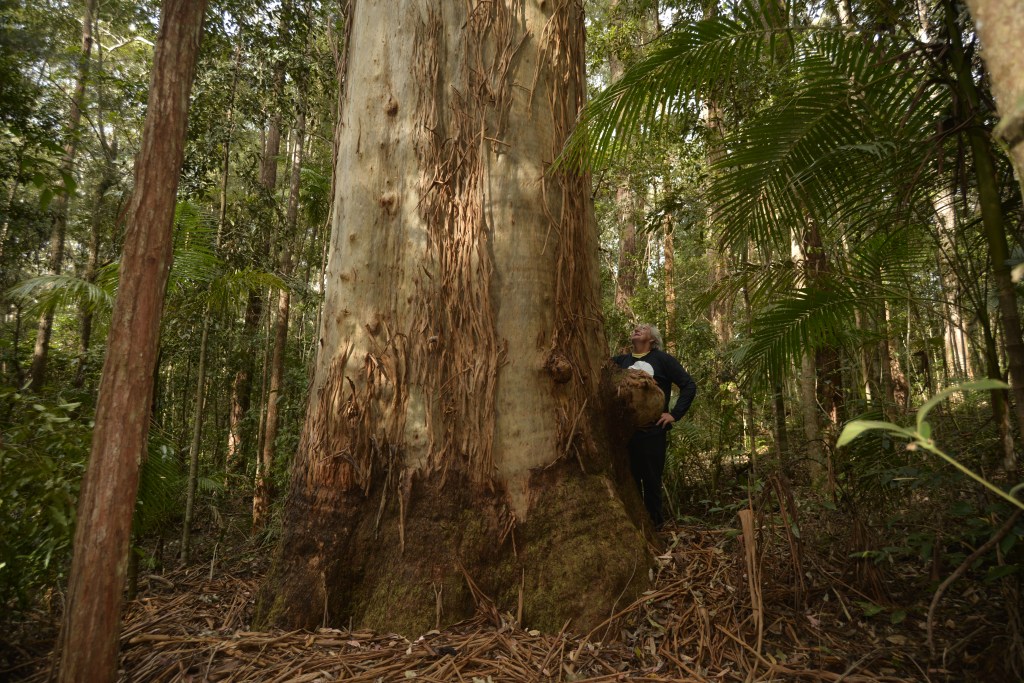
Pine Creek líes in traditional Gumbaynngirr country and drains a part of the coastal plain and foothills a little north-east of the beautiful township of Bellingen on the NSW mid-north coast. Much of the central and coastal parts of the catchment are clothed in dense wet sclerophyll eucalypt forest and gully rainforest. Between 1878 and 2003 much of this forest was Pine Creek State Forest and it was one of the oldest and most productive commercially exploited, publicly owned timber reserves in NSW. As almost all of the forest lies over gently undulating land almost every square metre of it was exploited for its rich hardwood timbers for over 120 years.
Logging
In the early days this logging was selective, only taking the biggest and straightest of trees, but in the 1950s, with the advent and wider application of the bulldozer and modern chainsaws, the logging intensified, the exploitation became more industrial in scale, and more environmentally destructive, and the locals began a long campaign to protect it from further damage. These locals knew the forest contained a large koala population as well as many other rare native birds, mammals and plants and were determined to mitigate the wanton destruction of nature that they witnessed occurring there.
There has been ongoing and unresolved conflict over timber harvesting in Pine Creek State Forest (PCSF) since early 1995. The NSW National Parks and Wildlife Service (NPWS) withdrew the license State Forests held for logging in PCSF in October 1995 as a consequence of extensive clear felling of core koala habitat contrary to lawful regulation. Continued community pressure brought about a NSW government commitment to the formation of a diverse committee made up of representatives from NSW State Forests, the NPWS, the timber industry, conservation groups and an independent koala scientist, to oversee the preparation of a Koala Management Plan for the forest in an effort to resolve the developing conflict. Scientific Research was undertaken during 1995-96 and after almost two years a Koala Management Plan was prepared.
Pine Creek koalas
What became clear from the research undertaken for the Plan was the state significance of the Pine Creek koala population, numbering an estimated minimum of 400 individuals. The Plan was reviewed and made available for public comment. The overwhelming public response expressed concerns that the Koala Management Plan would not adequately protect the koala population. The ‘interim’ nature of the planned koala reserve it proposed was disturbing and the Plan allowed high impact ‘gap style’ forest clearing operations to continue. The locals were not appeased.
Due to these concerns and in order to gain the best guarantee for the long-term protection of the Koalas of Pine Creek, the North East Forest Alliance (NEFA) and the Pine Creek Koala Support Group (PCKSG) had no other alternative other than to put forward the Pine Creek National Park Proposal in July 1998.
Pacific Highway
Around this time a major highway upgrade was announced for the Pacific Highway through the Bonville area. This proposal bisected PCSF, cutting it neatly into two disjunct pieces and because of its now recognised State significance as a major koala population a Koala Study was tendered out and awarded to the Australian Museum to gauge the impacts of a major highway construction on a koala population.
Koalas were caught, radio collared and tracked over a six year period, two years prior to highway construction, two years during construction and two years post construction. This Koala Study provided valuable information regarding accurate home range sizes of numerous Pine Creek Koalas, primary food trees and preferred browse trees. The study was the first to recognise that Forest Oak (Allocasuarina torulosa) is an important part of the local koala’s diet, comprising 25% by weight of faecal pellets and concluded that ongoing logging activity was a possible reason for a considerable decline in the koala population of Pine Creek.
Friends of Pine Creek
Logging recommenced in 2001 and once again community concerns were raised. The Friends of Pine Creek (FOPC) community group was formed and released a community discussion paper, ‘Reservation Options for Pine Creek State Forest’, seeking comment on the best way to protect PCSF. FOPC initially consisted of representatives from the PCKSG / the Bellingen Environment Centre/ the Native Forest Network/ Ulitarra Society and the Rainforest Information Centre.
National Park addition
At the beginning of 2003 the then Labor Premier of NSW, the Hon. Bob Carr visited the North Coast and announced that if his government was re-elected, he would make PCSF a national park as part of the iconic listed Native Forests of NSW, principally because of its large koala population. He honoured his promise when re-elected in 2003 and approximately half of Pine Ceek State Forest (3000 hectares) became National Park added to the adjoining Bongil Bongil National Park that lay immediately to its east, and half remained State Forest, approximately 1000 hectares of native forest and 1900 hectares of hardwood plantation (single species forest of native trees planted in lines).
Plantations
In 2006 the clear felling of these hardwood plantations began in earnest and by 2011 over 1500 hectares had been clear felled. Considering the findings of the Australian Museum Study this clear felling would have had a major impact on the koala population of PCSF – disrupting social groups, destroying established home ranges and making movement across the landscape far more hazardous.
In May 2012 the then NSW Environment Minister, the Hon Robyn Parker MP from a Coalition government, suspended the Koala Management Committee and approved the cessation of the ‘Koala Management Plan’. The resumption of clear felling and large-scale logging operations that resulted from this political decision have heavily impacted on the Koala population in PCSF.
Native Forest Logging
Native forest logging was proposed to commence December 2021 until April 2022 in Compartments 26 and 27 (now Compartments 007, 008, 009). This now appears to be rescheduled for December 2023, at least partially in response to ongoing community concerns and opposition, however it could be logged at any time without much public notice.
Recognition of significance In 2021 Bongil Bongil National Park and Bindarri National Park, that bookend Pine Creek State Forest to the east and north, were included in a new category of protection by the National Parks and Wildlife Service having been listed as ‘Assets of Intergenerational Significance’ (AIS) for the Koala. This status formally recognises both national parks as providing critical habitat for the koala and are assets of state significance for their ongoing conservation.
A Conservation Action Pan (CAP) is required by law for all AIS listed areas and is now being prepared. This Plan must include affirmative on-ground action to conserve the koala and the identification of key risks to the area, koala habitat values and priority actions that must be adopted to reduce risks to the environmental health and core environmental values of these national parks.
Land bridge
Bongil Bongil and Bindarri National Parks both adjoin Pine Creek State Forest to form a continuous belt of publicly owned native forest from the coast to the tablelands. The free and safe movement of Koalas is critical for the long-term survival of the species and facilitates gene mixing as well as helping mitigate the negative effects of catastrophic events such as heat stress, fire or drought.
The ongoing destruction by logging of sections of Pine Creek State Forest potentially cuts the link between these two national parks and reduces the safe passage, recruitment and dispersal of animals from one area to the other. For this reason, FOPC consider logging in Pine Creek State Forest as a key threat to the Koala populations of both Bongil Bongil and Bindarri National Parks. The FOPC advocates logging in PCSF must be identified as a key threatening process in the CAP for both Bindarri and Bongil Bongil National parks as koalas in both these conservation reserves recently listed as AIS areas would periodically move into and out of PCSF.
In July 2020, local Nationals MP, Gurmesh Singh, hosted a visit from the then NSW Environment Minister, the Hon Matt Kean at the Koala Tree Parents site, an area in Bongil Bongil NP where volunteers have planted thousands of koala food trees. During this inspection, Minister Kean expressed a passionate interest in the fate of local koalas and what could be done to improve their conservation status in the Coffs Coast area.
Forest Bridge Proposal
In response to this genuine request from the NSW Environment Minister ‘The Forest Bridge Proposal’ (2020) was prepared by current members of Friends of Pine Creek and submitted to the NSW government through The Hon Matt Kean MP in September 2020 for its consideration and support.
The Friends of Pine Creek will continue to lobby for the permanent protection from logging for all the native forest of Pine Creek State Forest, for the creation of the ‘Forest Bridge’ and its inclusion as protected conservation lands, a landmark decision that will link forever Bongil Bongil and Bindarri National Parks and provide enduring protection for the koala and many other native birds and animals.
Help us help our forests. Whatever we do, we cannot do it without you.

 Friends of Pine Creek